




It was about 30 years ago that blindness from glaucoma in his right eye ended Kirby Puckett’s career. It was 20 years ago last month that perhaps the greatest Twins player ever died from a stroke.
The legendary Twins centerfielder, who was a five-tool superstar, saw his brilliant MLB career end far too early after 12 seasons and at age 36. He later died as a relatively young man of 45.
It was March 28, 1996, in the final days of spring training, that the Chicago native who was hitting the cover off the ball, woke up with blurred vision. The player with the infectious smile and personality was quickly placed on the 15-day disabled list for the first time in a storybook career that included leading the Twins to World Series titles in 1987 and 1991.
Dave St. Peter recalled that in spring training of 1996 Puckett’s spirits were high. He was wearing a Breathe Right nasal strip and predicting he would be the first baseball player to earn an endorsement deal from the Minnesota company. “He had a great spring. Really looked good,” said St. Peter who then was working for the club’s communications department and would become team president in 2002.
Initially there was a feeling Puckett would recover and rejoin the Twins but that never happened. “Kirby had some of the best doctors locally and globally take a look and there were surgeries performed and efforts made but at the end of the day I think the damage had been done,” St. Peter said.
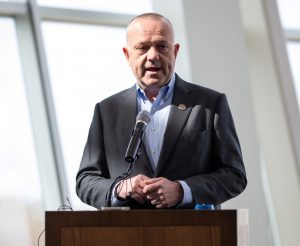
The gifted fielder, base running threat and power hitter with the lifetime batting average of .318 announced his retirement on July 12, 1996. Not surprisingly, Puckett tried to lift up those around him, including teammates and fans at his news conference. “Kirby was always one to try to make others feel good,” St. Peter remembered.
It was a devasting ending for Puckett, the team and the fans. The ball club lost the guy who invited teammates to jump on his shoulders for leadership and production. The club had added Paul Molitor in the offseason and there was renewed hope 1996 would reverse the trend of recent losing seasons.
The fans lost perhaps the most popular athlete in Minnesota history. A personality as big as his playing skills. “This was a guy that was bigger than life,” St. Peter said. “He had lit up every room he had ever been in.”
Puckett was a first-ballot Baseball Hall of Fame inductee in 2001. At age 41 he became the third youngest electee in history behind Sandy Koufax and Lou Gehrig.
Playing at about 5-foot-8 and 210 pounds Puckett had a dazzling career and impact on baseball that no one would have predicted when he was growing up as a little noticed high school player in Chicago. The Twins took a chance on him as a free agent college player in 1982. He became such a revered player that after his retirement the Twins made him an ambassador for the franchise.
The saga of Puckett’s vision loss impacted professional sports. Part of the narrative has always been that perhaps if his eye damage had been caught earlier things might have been different. “He was still a pretty young guy at the time and that (extensive screening) wasn’t customary across sports. Things evolve. I can assure you changes were made. Not just with the Twins, but I think across sports in general with Kirby’s story. I think it was a lesson learned. …”
Tragedy hit again on March 5, 2006 when Puckett suffered a massive stroke. The next day he died. In a March 7 story for MLB.com St. Peter called it “gut wrenching” to hear of the loss.
“This is a sad day for the Minnesota Twins, Major League Baseball and baseball fans everywhere,” Twins owner Carl Pohlad said in a statement in the MLB.com story. “Eloise and I loved Kirby deeply. Kirby’s impact on the Twins organization, the state of Minnesota and Upper Midwest is significant and goes well beyond his role in helping the Twins win two world championships.”
Puckett was a Twins ambassador for several years until the contract expired. Puckett walked away saying he wanted time to step back from the role, St. Peter recalled. Nevertheless, St. Peter made ongoing efforts to re-establish the ambassador position with him.
In the years between retirement and his death personal problems surfaced for Puckett including a divorce from his wife Tonya. It seems fair to say that the joy and satisfaction Puckett felt as a player eluded him in retirement including after he moved to Arizona, the place where he died.
“I think Kirby struggled with his post playing career largely because he struggled without the structure that the playing career brought,” St. Peter said. “There is a discipline and a framework that goes into being a professional athlete. And sometimes we see when that athlete is taken out of that environment things don’t come as naturally to them. …In some ways Kirby went to a darker place without baseball.”
For another perspective on Puckett, I turned years ago to Gregg Wong, the former Pioneer Press sportswriter who was a beat writer on the Twins for a few seasons and covered the club part time during other seasons. Here is what he wrote to me:
“He was the most upbeat, most accessible athlete I’ve ever dealt with on a regular basis. He would light up whatever room he was in with his non-stop chatter, banter and energy. The noise level in the clubhouse always would go up once he walked in.
“He always had something to say for the record. A lot of times it might just be a cliché, but he always was there to face the music. He never ran and hid, like many top athletes, even if he struck out with the winning run on base in the bottom of the ninth. He was a true professional in that regard; he knew you had a job to do, too.
“Probably my favorite remembrance of him was when he made his first all-star team in 1986, where he was voted in as a starter. The paper did not send me to the game in Houston, but the boss wanted a Puckett sidebar after the game. I asked if he would call me as soon as the game got over so I could ask about his experience and he said he would, although I believed he would get caught up in the hype and hoopla and forget to call.
“I watched the game on TV, made some notes and prayed that he’d call. Five minutes after the game was over, the phone rang. ‘What’s up, Wongie?’ he said. ‘How you doin’?’ Here he had just ended the biggest moment of his career up to that point and he remembered to call and asked how I was doing (just fine because he called)! Not many pro athletes would do anything like that today — and certainly none of the Vikings I covered in a half-dozen years.”
Worth Noting
If Michigan meets Illinois in the NCAA championship game next Monday, why will it be historical? (Pause and think. Then read below).
Because the last and only time two Big Ten schools played for the title was 1976 with Indiana defeating Michigan for the crown. Who were the coaches? (Pause again).
Indiana: Bob Knight. Michigan: Johnny Orr.
Congratulations to the Minnesota Football Coaches Association on its most recent clinic and upholding the standard of excellence the event has set over the years. In addition to clinic sessions, the MFCA honored Tom Schuller (Jackson County Central) as Coach of the Year and Chad Johnston (Minneota) as its Tom Mahoney Man of the Year.
Hall of Fame Inductees from the high school division are John Clark, Jr., Mahnomen-Waubun; Ronald Johnson, Clearbrook-Gonvick; Bob Kovich, Lakeville North; Jeff Schlieff, Spring Lake Park; and Randy Strand, Adrian. From the college division is inductee Glenn Caruso from St. Thomas.
Honored with the Cal Stoll Award are Ryan Beachy, Pelican Rapids; Kyle Stern, LeRoy-Ostrander-Lyle-Pacelli, and Tim Kirk, Mountain Lake. Terry Kent, Kittson County Central, won the 2026 Broyles Award honoring top assistant coaches in the United States.
Congratulations to all honorees!
You needed to include the FB Coaches Association Coach of the Year….Tom Schuller of the Back- Back State Champion JCC Huskies
Addition made. Thank you.