Skip to content
David Shama's Minnesota Sports Headliners
Menu
  • Gophers
  • Vikings
  • Twins
  • Timberwolves
  • Wild
  • United
  • Lynx
  • UST
  • MIAC
  • Preps
Menu
Blaze Credit Union

Dinkytown Athletes

Murray's Restaurant

Meadows at Mystic Lake

Iron Horse | KLN Family Brands | Meyer Njus Tanick | Tommie’s Locker Room

Category: Vikings

Temps Nippy but No “Cold Omaha”

Posted on February 4, 2018February 5, 2018 by David Shama


For those old enough to remember, there were references in this town in the 1970s about becoming a “cold Omaha” without major league sports. Back then the Twins and Vikings were upset about their revenues at Met Stadium. They were interested in new homes—either in Minnesota or elsewhere.

The powerful Minnesota politician Hubert Humphrey warned that without these teams Minneapolis could become a “cold Omaha.”

Today, as the world watches Super Bowl LII from Minneapolis, we know we have distinguished ourselves from the largest city in Nebraska. Omaha remains without major league teams, but not us. The Twin Cities are one of only nine American markets with franchises in MLB, the NFL, NBA, NHL and MLS. This area has also hosted the World Series, the Stanley Cup Finals, WNBA Finals, all-star games, the NCAA Final Four, top golf tournaments and Super Bowls.

Boston, Buffalo, Denver, Chicago, Cleveland, Cincinnati, Indianapolis, Milwaukee, Philadelphia, Pittsburgh and the list goes on of northern cities that have never hosted all the events we can claim. And today’s Super Bowl will be the second in Minneapolis, following the 1992 game that was a big deal, but nothing like this week-long entertainment extravaganza leading up to America’s premier sporting event when more than 100 million people are expected to watch on TV.

What was that line in the Mary Tyler Moore TV song that showed Mary on the Nicollet Mall ?

“Looks like we made it after all!”

U.S. Bank Stadium

Mr. Humphrey, mayor of Minneapolis in the late 1940s and two decades later vice president of the United States, has been dead for many years but he can rest easy about the sports landscape in his adopted home town that replaced the Hubert H. Humphrey Metrodome with a palace known as U.S. Bank Stadium and the site of today’s game between the Eagles and Patriots.

In anticipation of angry texts and email threats from Nebraskans, let me state (I am willing to take a lie detector test) that I have no problem or criticism with the fine city of Omaha. There must be a reason the admirable values of their citizens are depicted in American movies (see “Up in the Air” and “About Schmidt”). The town is home to Warren Buffet, and I can’t think of a celebrity neighbor I would rather have.

Omaha is also located in Big Red country. As a college football fanatic I am not so sure I wouldn’t trade the last 60 years of Minnesota pro sports for Cornhuskers football and their five national championships. (I will decline a lie detector test this time.)

Back in the 1950s Minneapolis-St. Paul was without professional baseball and football. Civic leaders wanted this area to be known as more than “flyover country.” Minneapolis Chamber of Commerce and other business leaders led the drive to put us on the same map as similar size cities like Kansas City and Milwaukee who had acquired big league baseball franchises from other towns in the 1950s.

With the bonding authority of the city of Minneapolis, it was possible to build Metropolitan Stadium. The facility opened in 1956 with the intent of attracting major league baseball and pro football. Rumors circulated that baseball’s Indians, Giants or White Sox might relocate here. Chicago’s football Cardinals looked like a possibility for a move to the new stadium in Bloomington.

But it was the Washington Senators in 1960 who decided to move here and provide Minnesota with a major league baseball team. In 1959 Minneapolis had been rumored for a franchise in the proposed Continental League but that entity never materialized. About the same time the American Football League was organizing and Minneapolis was considered a likely member, but the NFL decided to expand and the Vikings began play in 1961.

This town secured big league status in the 1960s when not only the Twins and Vikings arrived, but the expansion North Stars joined the NHL. However, that status was threatened in the 1970s when the Vikings and Twins got restless. There were rumors both franchises could be headed to other cities and warmer climates.

Metropolitan Stadium was a baseball-first facility with sightlines and seating capacity favoring the Twins. The Vikings needed more than 47,000 seats, and management wanted new revenue sources such as private suites. The Twins anticipated the lucrative novelty of not only the honeymoon period in a new facility, but one with a roof guaranteeing games couldn’t be rained (and snowed) out.

Adding to the drama was Minneapolis power brokers regretted locating the Minnesota home of professional baseball and football on the prairie in Bloomington. The “Big Cigars” envisioned a downtown dome bringing hospitality dollars to the central city and spurring economic development.

The Metrodome opened in 1982 as the home of not only the Twins and Vikings, but also Golden Gophers football. Not only were baseball and football saved for future generations, but the 65,000 seat facility attracted the Final Four, concerts, truck pulls and a long list of other activities including public rollerblading.

This town’s worries about remaining big league surfaced again in the late 1990s and early 2000s when the Twins and Vikings became restless. The Metrodome was built on the cheap and had many flaws including its infamous crowded concourses. With more modern stadiums being built around the country, the blueprint was in place to upgrade the fan experience in both baseball and football with separate facilities for the Vikings and Twins, and generate more revenues for the franchises.

It was no easy task but the Twins, with help from Hennepin County, and the Vikings with backing from the state of Minnesota and city of Minneapolis, got their own homes with the building of Target Field and U.S. Bank Stadium. Target Field, open since in 2010, has regularly been included on lists ranking the top 10 baseball stadiums. U.S. Bank Stadium is mentioned in the first sentence or two about the best enclosed facilities in North America.

The pre-game and in-game TV audiences for today’s Super Bowl will likely hear about many things Minnesotan. This will be the coldest day ever for a Super Bowl and viewers in warmer places (that’s most towns) will chuckle. Viewers will also wince when they hear mention of below zero wind chills and yesterday’s snow fall in the “Bold North.” Those weather reports could cue cameras to show a frozen backyard pond here in the State of Hockey and other activities to document how locals embrace winter.

There will be references to how the Vikings almost made it to Super Bowl LII before losing to the Eagles in the NFC title game. That could make Vikings fans cringe as will the mention of the franchise’s four Super Bowl appearances—all loses. But when the talking heads get done with the stuff that is mundane to us, there will be references to U.S. Bank stadium and the civic pride this town can feel for having that building and hosting this Super Bowl.

The new home of the Vikings is an extraordinary structure of glass and steel that’s been drawing regional and national attention for more than 18 months. When the $1.1 billion facility opened in the summer of 2016 the fact list included the following: More than $60 million spent on technology, seven stadium levels with 430 concession points of sale, 37 escalators, 11 elevators, 979 restrooms, 350 pieces of commissioned art and 250 photographs.

But to many fans the signature features are the 60 percent clear roof bringing natural light into the stadium and the five giant pivoting doors that on warm days are opened. Those features provide an outdoor feel to the stadium experience and have muted second-guessing about how the facility should have a retractable roof.

Since the late 1980s Minneapolis and St. Paul have seen an arena and stadium building boom that no other area in the country probably can claim. Target Center, Xcel Energy Center, TCF Bank Stadium, Target Field, CHS Field, U.S. Bank Stadium and the soon to be opened MLS stadium have become home to the Timberwolves/Lynx, Wild, Gophers, Twins, Saints, Vikings and United. At the cost of over $2 billion in public and private funding, we’ve heeded the warning of becoming a “cold Omaha.”

Those who don’t like the greed and other misbehavior often associated with professional sports can shake their collective heads at what we’ve done. But no one can deny that this town and state do sit front and center on the North American stage today.

1 comment

Eagles Fans Create Poor Impression

Posted on February 1, 2018February 1, 2018 by David Shama


Basketball immortal Red Auerbach used to say forgive but never forget. That might be the mindset of some Vikings fans Sunday when they passionately cheer for the Patriots instead of the Eagles in Super Bowl LII at U.S. Bank Stadium.

Such fans have incentive to see a Patriots win that goes beyond the Eagles ending the Vikings’ Super Bowl dream in the NFC championship game on January 21 in Philadelphia. The Eagles won 38-7 and Vikings fans attending that game in the “City of Brotherly Love” certainly didn’t encounter a welcoming atmosphere.

Philly is famous for a lot of things—a few of them not exactly chamber of commerce bulletin board material. The town where Eagles fans once booed Santa Claus went way beyond that transgression when the Vikings were in town. USA Today reported last Friday social media depicted a “hostile environment” for Vikings fans.

“Some Minnesotans were booed, taunted and the subject of expletives at close range as they walked through the parking lot,” the newspaper wrote. “Another video showed what appeared to be full cans of beer being thrown at Vikings fans.”

Former Viking tight end Doug Kingsriter, who played on Minnesota Super Bowl teams in the 1970s, didn’t have to check out social media to know about the hostility. He and family members were at the game and experienced the unfriendly environment. “There were a number of ‘in your face’ encounters, but we just smiled and kept walking,” Kingsriter said via email to Sports Headliners.

Kingsriter, who grew up in Richfield experiencing Minnesota nice, also encountered Eagles fans at the game who were embarrassed by the behavior of Philly troublemakers. He wrote: “There were more than 20 Eagles fans who approached our group (son, daughter and daughter-in-law) to let us know that ‘not all Eagles fans were jerks.’ These were kind, gracious people. What those folks said helped us to mitigate the groups of mostly young men who would point at us and yell, ‘blow,’ and other somewhat unmentionable phrases.”

While Kingsriter described the scene as an “interesting experience,” he is keeping a balanced view about the incidents. “We did not find it intimidating due to the kindness of those people who took the time to welcome us and our team (the Vikings) to Philadelphia. They were the ‘City of Brotherly Love’ representatives.”

Since the January 21 game, some Eagles fans have donated thousands of dollars to the Mike Zimmer Foundation as a way of apologizing for the rowdy and confrontational behavior of others. The foundation honors the “giving spirit” of Vikki Zimmer, the late wife of the Viking head coach. The foundation provides “opportunities to the youth of today to benefit the future of tomorrow,” according to the website.

Worth Noting

Sunday’s game will be the fourth Super Bowl for the Eagles franchise, the same number of big game appearances as the Vikings. Ten other franchises have played in more Super Bowls, led by the Patriots who make their 11th appearance Sunday.

When the Vikings played in their first Super Bowl in 1970 the price of an ad on the telecast was $78,000. This year the cost for a commercial is about $5 million.

The Vikings’ last Super Bowl appearance in 1977 drew a national TV rating of 44.4 and 73 share. Those numbers are similar to recent Super Bowls and what can be expected from Sunday’s telecast on NBC. Ratings are a percentage of the potential TV audience watching a particular program. A share is a percentage of televisions on at that time viewing a program.

When the Vikings lost to the Raiders in the 1977 Super Bowl each player received $7,500. The Raiders earned $15,000. The winners’ shares in 2018 will be $112,000, while losers receive $56,000 each.

Case Keenum (photo courtesy of Minnesota Vikings)

Journeyman Case Keenum’s performance for the Vikings last season approached star status, but despite 2018 free agency a source close to the team’s front office doesn’t expect Keenum to be unreasonable in contract negotiations. He described Keenum as “old school” in attitude and predicted the quarterback who never established himself in four previous NFL seasons will remain a Viking. “He isn’t going anywhere,” the source said.

The Vikings are looking for a new offensive coordinator to replace Pat Shurmur who is the new head coach of the Giants. In the hiring process general manager Rick Spielman and head coach Mike Zimmer are likely to value the approach of Shurmur who adapted his system to the talent of the players, instead of mandating a style of play.

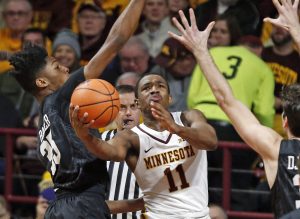
Richard Pitino’s Gophers basketball team is 1-7 since center Reggie Lynch was suspended. Another starter and high impact player, forward Amir Coffey, has missed six of those games because of injury. Interest in the team has declined and the Gophers could lose their remaining seven Big Ten regular season games including Saturday at Michigan. Minnesota is 14-10 overall, with a 3-8 conference record.

The nosedive of a team that once was rated among the top 15 in the country is impacting the box office, too. Before January the Gophers were on track to potentially sell out most of their Big Ten home games. It’s likely that the collapse on the court will result in at least 1,000 fewer tickets sold per game for five league games this winter. At an average of $55 per ticket that’s a total of $275,000 in potential lost revenue. And those numbers seem conservative, and don’t include other revenues like concessions and parking.

It’s interesting Kevin McHale is part of the inaugural class of the Minnesota High School Basketball Hall of Fame. McHale probably wasn’t even the best big man in the state his senior season at Hibbing in 1976, with that distinction going to Steve Lingenfelter from Bloomington Jefferson.

The gangly 6-foot-10 McHale was an evolving talent as a teenager. He was a better college player at Minnesota than he was a prep at Hibbing. He became one of the NBA’s greatest players during a career that included three NBA titles with the Celtics.

The Saint John’s men’s basketball team is running away with the regular season MIAC race. The Johnnies defeated Concordia-Moorhead last night to make their overall record 18-1 and 14-0 in MIAC games. If the Johnnies finish the league season undefeated, they can look back to an overtime win against Bethel last Saturday as pivotal.

Comments Welcome

“Crown Jewels” among U Walk-ons

Posted on January 30, 2018January 30, 2018 by David Shama


A Wednesday notes column with the focus on football:

Don’t expect the Golden Gophers to add any scholarship football players to their recruiting class of 2018 when the second of two National Signing Dates occurs February 7. Coach P.J. Fleck has no remaining scholarships but next week expect Minnesota to announce the names of “seven to nine” preferred walk-ons, according to Ryan Burns, the college football recruiting authority and publisher of GopherIllustrated.com.

Burns told Sports Headliners the “crown jewels” of that group will be Zack Annexstad and Max Janes. Annexstad, a Mankato, Minnesota native, was outstanding last fall as a pro-style quarterback at IMG Academy in Florida. Burns said Janes, a tight end and linebacker from Mounds View, turned down four Division I offers to become a Gopher. While preferred walk-ons don’t receive scholarships, they put themselves in position to earn assistance by future performances.

Ryan Burns

It was thought the state’s Mr. Football as chosen by the Minnesota Football Coaches Association in December might agree to a walk-on offer from Fleck but Burns believes Eden Prairie linebacker Antonio Montero is accepting a scholarship to either Rice or San Diego State. Montero recently visited both schools.

Eden Prairie quarterback Cole Kramer, who will be a senior next fall and helped lead the Eagles to the 2017 6A state title, has verbally committed to Minnesota as a scholarship player for the class of 2019. Fleck has stressed the importance of having legacy players in his program, and Kramer is the grandson of former Gopher football MVP Tom Moe who also became athletic director at Minnesota.

Owatonna running back Jason Williamson has also verbally committed to Minnesota’s class of 2019. Burns said Iowa had interest in Williamson and Michigan State was following Kramer.

Fleck and his staff will headline the annual MFCA Clinic April 5-7 at the DoubleTree Park Place in St. Louis Park. South Dakota coach Bob Nielsen will be among the speakers.

Former Gopher football captain Jim Carter said his friend Mike Sherels, the ex-University of Minnesota assistant coach under Jerry Kill and Tracy Claeys, has received an offer to join the Wake Forest staff as linebackers coach, and that Wisconsin also has interest in Sherels. Jay Sawvel, who worked with Sherels at Minnesota, is the defensive coordinator at Wake Forest. Popular with players and others associated with the Gophers, Sherels was a successful coach and recruiter who worked the states of Minnesota and Florida during his time at Minnesota.

Word is each player on the two Super Bowl teams can acquire about 15 tickets for Sunday’s game at U.S. Bank Stadium but only two are free. The other tickets must be purchased at face value, with a guesstimate the cost is over $2,000 per ticket.

Winning players in the game receive $112,000 each, losers $56,000.

A downtown parking spot near U.S. Bank Stadium that cost $40 during the Vikings season will go for $120 on Sunday.

Dave Mona believes the Super Bowl will likely return to Minneapolis after this year’s game but it will be at least 20 years. Northern sites for the big game are rare and that works against a U.S. Bank Stadium encore.

Mona, who helped establish a top public relations agency and for decades has talked sports on WCCO Radio, was involved with efforts for the 1992 Super Bowl at the Metrodome. Next Sunday he will be the press box announcer for the game between the Eagles and Patriots. Mona has the same assignment for Vikings games.

Vikings public address announcer Alan Roach, who has also worked previous Super Bowls, will be the P.A. man for the game Sunday. Roach grew up as Kelly Burnham and lived in Slayton and Brainerd Minnesota.

The 1992 Super Bowl was the first time the NFL offered the now popular fan experience headlined this year as “Get Inside the Game.” The interactive attraction is at the Minneapolis Convention Center through Saturday as part of Super Bowl activities, charging $35 for adults and $25 for children 12 and under. Fans can experience NFL games via virtual reality technology, run a 40-yard dash against NFL players on a giant LED screen, obtain autographs from NFL players and learn football skills at clinics.

Taste of the NFL, another high profile annual Super Bowl event, also originated here in 1992. Often referred to as the “party with a purpose,” the event has raised millions of dollars to fight hunger in the United States. Minneapolis restaurateur and philanthropist Wayne Kostroski founded the event and still leads it.

Eric Curry, the well-known college basketball referee from Minneapolis, has left his executive position at Sun Country Airlines. He officiated last night’s Wisconsin-Nebraska game in Madison.

The Gophers’ Hugh McCutcheon, a former Big Ten and American Volleyball Coaches Association Coach of the Year, speaks to the CORES lunch group March 8 at the Knights of Columbus Hall in Bloomington, 1114 American Blvd. More information is available by contacting Jim Dotseth, dotsethj@comcast.net. CORES is an acronym for coaches, officials, reporters, educators and sports fans.

Condolences to the family and friends of Twin Cities native Les Layton who died earlier this month. His career included newspaper, public relations and insurance work. Newspaper employers included the Pioneer Press and Sun publications.

Comments Welcome

Posts pagination

  • Previous
  • 1
  • …
  • 133
  • 134
  • 135
  • 136
  • 137
  • 138
  • 139
  • …
  • 277
  • Next
  • Home
  • Biography
  • Contact
  • Privacy Policy
  • Terms of Use

Search Shama

Archives

  Tommies Locker Room   Iron Horse   Meyer Law   KLN Family Brands  

Recent Posts

  • Return of Cousins Could Mean a Battle for Viking QB Job
  • Hard to Believe Koi Perich Won’t Move on from Gophers
  • Timberwolves & Lynx CEO Says Arena in Minneapolis the Goal
  • Shadow of 2019 Success Hangs Over Gopher Football
  • 25 Years Calls for Remembering One Special Sports Story
  • Even Hospice Can’t Discourage Ex-Gopher & Laker Great
  • At 61, Najarian Intrigued about “Tackling” Football Again
  • NFL Authority: J.J. McCarthy Will Be ‘Pro Bowl Quarterback’
  • Vikings Miss Ex-GM Rick Spielman’s Drafts, Roster Building
  • U Football Recruiting Class Emphasizes Speed, Athleticism

Newsmakers

  • KEVIN O’CONNELL
  • BYRON BUXTON
  • P.J. FLECK
  • KIRILL KAPRIZOV
  • ANTHONY EDWARDS
  • CHERYL REEVE
  • NIKO MEDVED

Archives

Read More…

  • STADIUMS
  • MEDIA
  • NCAA
  • RECRUITING
  • SPORTS DRAFTS

Get in Touch

  • Home
  • Biography
  • Contact
  • Privacy Policy
  • Terms of Use
Blaze Credit Union

Dinkytown Athletes

Murray's Restaurant

Meadows at Mystic Lake

Iron Horse | KLN Family Brands | Meyer Njus Tanick | Tommie’s Locker Room
© 2026 David Shama's Minnesota Sports Headliners | Powered by Superbs Personal Blog theme
We use cookies to ensure that we give you the best experience on our website. If you continue to use this site we will assume that you are happy with it.