Skip to content
David Shama's Minnesota Sports Headliners
Menu
  • Gophers
  • Vikings
  • Twins
  • Timberwolves
  • Wild
  • United
  • Lynx
  • UST
  • MIAC
  • Preps
Menu
Dinkytown Athletes

Murray's Restaurant

Meadows at Mystic Lake

Blaze Credit Union

Iron Horse | KLN Family Brands | Meyer Njus Tanick

Category: Gophers Football

Here’s Your College Football Finale

Posted on December 7, 2017December 7, 2017 by David Shama


The University of Minnesota season is over but my college football notebook has unfinished business. Here’s an offering of year-end thoughts about not only the U, but also the Big Ten Conference and national scenes.

Many Gophers fans remain open-minded after one season of the P.J. Fleck era—disappointing as it was at 5-7, ending with just two league wins and outscored 70-0 by the final two opponents. That’s the fair approach because it’s too soon to judge Fleck and his staff.

The 37-year-old coach has big ambitions for Minnesota and will mostly either realize them or fail based on the talent of his players. Minnesota’s 2018 recruiting class is No. 31 nationally in the 247Sports composite rankings. If that impressive ranking sticks through Signing Day on December 20, the Gophers will have their highest ranked recruiting class since 2008 and head coach Tim Brewster.

A prominent businessman, U alum and big-time Gopher booster thinks Fleck is going to be a coaching star. He told me this fall Minnesota will be on its way as soon as Fleck’s second season. The view from here: with so many inexperienced and new players in 2018, that’s not likely.

Fleck needs to not just eventually breakthrough with a couple of winning seasons, but more importantly develop a program with continued success. Can he do it?

That’s the golden question in Dinkytown. He has only been a head coach for five years. At Western Michigan he had one knockout season, his last one in 2016 when the Broncos were 13-1 and a damn good team. His first season at Western, in 2013, the record was 1-11, then came two 8-5 years.

Fleck’s combined record as a head coach is 35 wins, 29 losses. Certainly circumstances, including resources available, have much to do with a coach’s record but it’s interesting the Broncos program he left behind was just 6-6 overall and 4-4 in Mid-American Conference games this past season. Maybe the Broncos missed Fleck’s leadership that much, or perhaps he left a program still not built for sustained high level success.

The Mid-American has long been an incubator of coaches going on to big-time jobs—from Ara Parseghian to Urban Meyer. The league has also produced its share of Big Ten coaching busts including Darrell Hazell who was a one-season hit at Kent State before piling up the losses at Purdue over four years. Brady Hoke used some brief success at Ball State to move on to San Diego State for two seasons before he failed at Michigan.

Gophers’ athletic director Mark Coyle is all in on Fleck, having hired him for more than $3 million annually last January. This fall Coyle proposed extending Fleck’s original five-year contract through the 2022 season (pending Board of Regents approval next week).

The opinion here is the first attribute an athletic director needs is the skill to identify and hire the best coaches. How is Coyle doing?

It’s too soon to judge Coyle who was hired at Minnesota in 2016. However, it’s interesting that Fleck isn’t the only ex-Mid-American head coach with limited experience and success that Coyle has hired. As Syracuse’s athletic director he hired Dino Babers who coached at Bowling Green where he was 18-9 in two seasons and won the 2015 MAC championship. Babers has coached Syracuse for two seasons with 4-8 overall and 2-6 ACC records both years.

Among the best things that have happened to Gophers football this century is being placed in the Big Ten’s West Division. The power in the conference rests in the East where bullies Ohio State, Michigan, Michigan State and Penn State are usually better than most teams in the West—or is that all except for Wisconsin?

Mike Riley was the wrong coach for Nebraska but his presence in Lincoln was a plus for the Gophers who beat his team 54-21 this season. New hire Scott Frost looks like instant improvement for “Big Red” and leaves the West Division with only one apparent coaching soft spot, at Illinois where Lovie Smith is 5-19 (2-16 Big Ten) in two seasons.

The coaching scene in the West Division looks like it’s really settling in except for some drama at Minnesota and with the Illini. Frost, the former Nebraska quarterback who turned UCF from a 0-12 team in 2015 to an undefeated one this fall, looks like a perfect fit in Lincoln. Northwestern, with former Wildcat All-American linebacker Pat Fitzgerald heading the program with success since 2006, is already the West Division’s legacy model fit.

As head coach, Wisconsin’s Barry Alvarez resurrected Badgers football in the 1990s. As athletic director, he remains the CEO of the program. Now with Madison native and Alvarez disciple Paul Chryst as head coach the Badgers keep winning division titles, and it’s “On Wisconsin” every year.

It’s not easy to win at Iowa but head coach Kirk Ferentz has made an 18-year career as the Hawkeyes boss. Here and there Iowa has known glory including the 2016 Rose Bowl and the day this fall when they embarrassed Ohio State with a 55-24, beat down in Iowa City. Things remain stable at Iowa with Kirk’s son, Brian Ferentz, seemingly a solid bet to one day succeed his dad as head coach.

Jeff Brohm’s first season as Purdue head coach gave long suffering Boilermaker fans some bright moments including a 31-17 win over the Gophers. Purdue, with an overall 6-6 record and 4-5 in the Big Ten, will play in its first bowl games since 2012. A year ago Purdue finished 1-8 and 3-9 under Hazell. With his offensive pedigree, Brohm could be the right guy at a school that years ago was referenced as “Quarterback U.”

The Gophers are the opposite of “Quarterback U.” Minnesota’s last All-American quarterback was Sandy Stephens in 1961. The NFL last drafted a Gophers quarterback in 1972 when Craig Curry was an eighth round pick.

Quarterback Victor Viramontes, the junior college transfer from California expected to sign with Minnesota December 20, is already a social media fave of Gophers fans. He was even interviewed on WCCO Radio’s “Sports Huddle” last Sunday before going to church.

Perhaps Viramontes, who has drawn comparisons to former Florida Heisman winner Tim Tebow, can emerge as a starter next year and also a star. The Gophers will need box office appeal not only because of this year’s record. The home schedule is not exactly a who’s who of college football—New Mexico State, Fresno State, Miami (Ohio), Iowa, Indiana, Purdue and Northwestern.

Speaking of college football’s elite, the Big Ten was left out of the four-team playoff to determine the national champion. The selection committee may well have put the best teams in the field—it’s hard to vote for the Big Ten champion Buckeyes after the debacle in Iowa City—but the playoffs do have a provincial look. Alabama, Clemson, Georgia and Oklahoma collectively cover a small part of America geographically.

The prediction here is that won’t happen in a few years because the playoff will likely be expanded from four to six teams. Champions from the five Power Conferences, plus a wild-card team would ensure more geographic balance and lessen second-guessing about who gets in the field. The motivation for going to six teams will also be to create more TV viewers and advertising revenues.

In case you didn’t notice, TV is king. The guy who spends $100 per ticket at the stadium isn’t as important as all those folks sitting at home in their recliners watching the endless parade of TV commercials. The ticket buyer is fortunate if he or she is provided more than six-days notice regarding the start time for the next game.

Meanwhile, the viewer at home may be sitting in his pajamas and enjoying all the game action up close on an Ultra HD TV. Commercials? Whoever invented the mute button is a genius.

1 comment
Memories Endure from Memorial Stadium

Posted on November 28, 2017November 29, 2017 by David Shama


It’s been 25 years since the University of Minnesota’s Memorial Stadium was demolished. With calendar year 2017 slipping away, it’s time to remember the Gophers’ old football home.

Minnesota played in the on-campus “Brick House” from 1924 through 1981 before moving into the Metrodome downtown. In my childhood and teen years I developed a passion for both the Gophers and the University on football Saturdays at Memorial Stadium. My dad was a longtime season ticket holder and attending games with him and my mother was a cherished ritual of fall.

I fondly recall the anticipation of each season and the football talk in our home. My father and I constantly argued about coach Murray Warmath. Dad thought the University made a terrible decision in the early 1950s not hiring Bud Wilkinson as coach. Wilkinson was a former Gopher standout as a player and became one of college football’s legendary coaches at Oklahoma. My father was constantly critical of Warmath, including his assessment of how the team blocked and tackled.

Warmath came to Minnesota in 1954 and had mixed results through the 1959 season. Then in 1960 the Gophers won the national championship. Between 1960 and 1962 Minnesota’s cumulative record was 22-6-1. During that era the Gophers also played in two Rose Bowls, losing to Washington and defeating UCLA.

Lets it be noted that Dad’s harping about Warmath’s coaching was more subdued in the early 1960s.

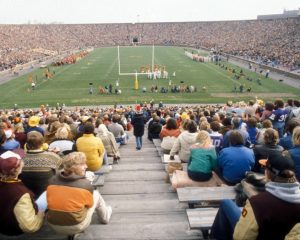
Memorial Stadium photo courtesy of Minnesota Athletic Communications

My father was a graduate of the University of Minnesota’s law school. He knew the campus well and to avoid traffic jams on football Saturdays he parked the car on the University’s West Bank. We walked across the old Washington Avenue Bridge and then several blocks further before arriving at Memorial Stadium. There are a couple of things about that walk I vividly remember including this:

Looking down at the Mississippi River while crossing that bridge scared the bejeebers out of me.

I recall, too, how there was pavement and grass down below part of the bridge at the west end. I regularly saw a small group of kids, about my age, gathered in the area. The enterprising 10 to 12 year olds liked to peer up at the masses crossing the bridge and yell, “Throw some money down!” Benevolent Gophers fans then showered them with pennies and other loose change from their pockets.

My dad insisted on early arrival at the games which started at 1:30 p.m. The stadium was mostly empty when we first sat in our seats about 12:15 p.m. The stadium loudspeaker blared John Philip Sousa’s “Stars and Stripes Forever,” while Boy Scouts assisted early arrivals in finding their seats. Soon the Gophers took the field for warm-ups. I knew who many of the players were because I studied the Goalpost stadium program and memorized their jersey numbers. These were my heroes and I was entertained by everything they did on the field including simple calisthenics like jumping jacks.

When it was close to kickoff time the marching band took the field and played the “Minnesota Rouser.” I didn’t need the drama of a border rival game, or marquee opponent like Michigan to get me excited because the “Rouser” always sent chills up my spine.

For late season games there was also a different cause for chills. On cold November days I was wrapped up in a blanket, wearing winter clothes, and shivering so badly I thought the shakes might become a permanent condition.

I sat through rain, sleet and snow at Memorial Stadium. Mostly the conditions had little impact on the outcome of the games but in late October of 1955 there was a snowstorm in Minneapolis. At snowy Memorial Stadium the Gophers upset the No. 10 ranked Southern California Trojans. The SC roster was loaded with California boys and my dad always claimed the Gophers pulled off an upset that day because the warm-weather-bred-lads had never experienced the elements they faced in Minneapolis.

Most of the time fans didn’t have much appreciation for the bench style seats that were in place throughout the stadium. The width of each numbered seat was minimal and near the conclusion of the national anthem aggressive fans used to plunk down and claim their wooden space as fast as possible.

However, when the weather turned cold the crowded masses were grateful to share the body warmth of nearby neighbors. On nippy days it was common to see a flask making its way out of someone’s pocket. Unlike today’s stadiums, alcohol wasn’t sold at Memorial Stadium so it was BYOB—sort of. Public address announcer Julius Perlt gave a stern announcement before every game regarding the consumption of alcoholic beverages being strictly prohibited!

The crowd, particularly in the student section, let out a chorus of good-natured (?) boos.

Perlt also stirred the emotions of fans with his announcements of upset scores from big games around the country. He gave the scores backward, setting up the drama. “In the Big Ten today, Michigan, 10 (long pause)—Northwestern, 21!”

When the Gophers were in their glory years Memorial Stadium was packed. I was at the Purdue game in 1962 when a record crowd of over 67,000 watched the Gophers beat the Boilermakers. The biggest of games had fans sitting in the aisles and brought out local celebrities like Minnesota Twins owner Calvin Griffith.

I saw my first game at Memorial Stadium in 1954 and then witnessed almost every game there through the 1981 season. A few of them, of course, are favorites starting with a long ago Iowa game. The rivalry with the Hawkeyes back then was probably more intense than now. The crowd was raucous on November 13, 1954 when Minnesota halfback Bob McNamara literally carried Iowa tacklers on his back in leading the Gophers to a dramatic 22-20 victory.

The drama was greater and the stakes higher in 1960 when No. 1 ranked Iowa came to play No. 3 Minnesota at the Brick House. All-American nose tackle Tom Brown dominated the Iowa offensive line and the Gophers beat up the Hawkeyes physically in a 27-10 win. Minnesota went on to win its first national championship since 1941 and play in the program’s first Rose Bowl.

I am not sure there has ever been a more anticipated home opener for the Gophers than in 1968 when nationally-ranked Southern California came to town featuring the most hyped player in college football—Orenthal James Simpson. Warmath let the Memorial Stadium grass grow long hoping to slow O.J. but the All-American tailback and the Trojans had their way winning 29-20.

In 1977 coach Cal Stoll, an energetic and rah-rah coach, was trying to revive the glory days of Golden Gophers football under Warmath and before that Bernie Bierman. Stoll never got the program turned around before being fired after the 1978 season but on October 22, 1977 he led Minnesota to one of its greatest upsets. The Gophers totally dominated No. 1 ranked Michigan and won 16-0.

In the 1970s the stadium was in need of repairs and upgrades. Stoll and other athletic department officials had plans to dome the Brick House, turning the old stadium into a climate-controlled environment that could be used for multiple activities. If not for the Vikings and Twins, those plans might have materialized. Minneapolis boosters wanted to move those teams from Met Stadium in Bloomington by constructing a downtown multipurpose domed stadium. They got their way with the help of the Minnesota Legislature, and the Metrodome opened in 1982 with the Vikings, Twins and Gophers as tenants.

Horseshoe-shaped Memorial Stadium, with its handsome brick exterior, stood for 10 more years before it was torn down in 1992 to make way for new buildings including the Aquatic Center and Alumni Center. The stadium’s name was a tribute to 3,527 University workers and graduates who served in World War I. Some of the stadium’s bricks were used in the 1990s to build nearby Mariucci Arena, while others were sold off to the public as keepsakes. A reconstructed Memorial Stadium arch inside the Alumni Center also pays tribute to the old stadium.

Every once in awhile I have a dream that the stadium is still standing. With so many memories, apparently my mind won’t let Memorial Stadium crumble to the ground.

2 comments

Piling on P.J. Fleck Won’t Help Gophers

Posted on November 26, 2017November 26, 2017 by David Shama


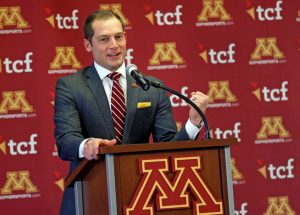
It’s too soon to make final judgments about whether first-year coach P.J. Fleck can establish a winning football program at the University of Minnesota. It’s not fair to conclude hiring Fleck last January was a mistake.

P.J. Fleck

Fan and media criticism about Fleck and the Gophers aren’t surprising following a disappointing end to the 2017 season. The Gophers lost four of their last five games to finish with a 5-7 overall record and 2-7 in the Big Ten. Minnesota was outscored 70-0 in its final games against Northwestern and Wisconsin.

The Gophers were mostly a bad offensive team during the Big Ten season. Minnesota finished 11th among conference teams in scoring at 18.4 points per game. League leader Ohio State averaged 46.3. While the Gophers were fourth in conference rushing, they placed 13th in passing yards averaging just 110.4 yards per game and producing seven touchdowns.

Fleck inherited a lack of talent and experience at the quarterback position. He’s not to blame for that, nor is it on him that the offensive unit lacked skills and depth in other places. The offense had its moments, including impressive production against Oregon State and Nebraska, but right now that unit has a long way to go.

Minnesota’s defense carried too much of the burden in trying to win games. The unit had its playmakers led by linebackers Jonathan Celestin and Thomas Barber but often lacked consistency in the biggest of games. The combination of defensive backs that left the program after the 2016 season and injuries this fall wrecked a promising secondary.

Mitch Leidner

Before the season a reasonable expectation seemed like a final record of 7-5, 6-6 or 5-7. The Gophers were 9-4 overall and 5-4 in conference games in 2016. Minnesota returned seven starters on offense and six on defense, but significant roster losses included quarterback Mitch Leidner who graduated, and two offensive linemen and two defensive backs with remaining eligibility who left school. The college football world isn’t static and to expect another 9-4 season wasn’t realistic.

But the opinion here is the coaching of Fleck and his assistants didn’t get the most out of the team. Minnesota lost close and winnable games to Iowa, Maryland and Purdue. The Gophers often lacked focus and sometimes even effort. Too many times there was obvious lack of execution including players in the wrong defensive gap, taking poor angles while tackling, or throwing foolish passes.

Neither the coaches nor players can blame their schedule for a disappointing record. Minnesota had a soft nonconference schedule, and faced more mediocre than quality opposition in the Big Ten. Minnesota also played five of its nine league games at home.

Fleck and his assistants—as with any new coaching staff—deserve to be judged mostly on their work over a period of time. The judgment day on Fleck is probably two years away. By then three seasons will be history and it will be more evident what the trend line is for a program that wasn’t broken when he came to town.

Fleck is trying to produce a conference champion at Minnesota for the first time since 1967. His progress toward that goal is obviously tied to improving the talent level, and 247Sports ranks the Gophers 2018 class No. 36 in the nation. That’s better than all but one other rival program in the Big Ten West Division, Wisconsin.

Fleck’s reputation as a superior recruiter will be tested at Minnesota where his resources include a new indoor practice palace. There are also challenges including the program’s losing reputation (no titles, mostly below .500 seasons in conference games for decades) and a fan base that can be characterized as both apathetic and cynical.

Those who rip Fleck yet want to see the Gophers become champions might want to think twice. Rival recruiters use any negatives they deem useful to influence high school prospects. This can be a very toxic town when it comes to U football.

Fleck told Sports Headliners last summer negativity won’t dampen his resolve. “I came here to bring the positivity,” he said. “I am one of the most optimistic people you’ll ever meet. I don’t care what people say about me negatively, that will never affect me as a person. …”

If Fleck signs a top 40 recruiting class next month that’s noteworthy. Nearly all of the program’s classes in the past haven’t been as highly ranked. Minnesota could even end up with the highest rated class in its division.

That would be a good start for Fleck and his assistants who probably will need to produce even more highly regarded classes in 2019 and 2020. Gophers fans can judge those classes not only by where they are ranked but also as they begin to see the skill sets of players on the field.

Fans should wait for more results before piling on Fleck. About 18 months ago another young Gophers coach was under heavy criticism including from University of Minnesota president Eric Kaler. Richard Pitino had produced a 2-16 Big Ten season in 2015-2016 and his players had embarrassed the program with off-court issues. This followed Pitino’s third season at Minnesota and three years of mostly struggles.

Then came a turnaround in 2017 when the Gophers went 11-7 in the Big Ten, finished fourth in the standings and qualified for the NCAA Tournament for the first time since 2013. Pitino’s team is showing even more promise this fall with a 7-0 start and top 15 national ranking.

Pitino, like Fleck, was hired as much or more for his recruiting acumen than anything else. It will be interesting to see if the 36-year-old Fleck can follow the path of Minnesota’s 35-year-old basketball coach.

4 comments

Posts pagination

  • Previous
  • 1
  • …
  • 162
  • 163
  • 164
  • 165
  • 166
  • 167
  • 168
  • …
  • 317
  • Next
  • Home
  • Biography
  • Contact
  • Privacy Policy
  • Terms of Use

Search Shama

Archives

  KLN Family Brands   Meyer Law   Iron Horse  

Recent Posts

  • LaMelo Ball’s Injury History Casts Shadow on Wolves Trade
  • Donations Saved Courageous Casey O’Brien’s Life
  • Minnesota Twins Just Keep on With Surprising Good Vibes
  • Indiana Football Success Hangs Over Gopher Program
  • Vikes Revel in State Hosting ’28 NFL Draft, Consider Combine
  • U AD: Golden Gophers in Good Spot in Rev Share, NIL
  • Gopher Men’s Hoops Not Starting Series with Tommies
  • U AD Talking Niko Medved & Dawn Plitzuweit Contracts
  • Don’t Expect Solo Act from New Vikings General Manager
  • Poor Arizona Defenses Did QB Kyler Murray No Favors

Newsmakers

  • KEVIN O’CONNELL
  • BYRON BUXTON
  • P.J. FLECK
  • KIRILL KAPRIZOV
  • ANTHONY EDWARDS
  • CHERYL REEVE
  • NIKO MEDVED

Archives

Read More…

  • STADIUMS
  • MEDIA
  • NCAA
  • RECRUITING
  • SPORTS DRAFTS

Get in Touch

  • Home
  • Biography
  • Contact
  • Privacy Policy
  • Terms of Use
Dinkytown Athletes

Murray's Restaurant

Meadows at Mystic Lake

Blaze Credit Union

Iron Horse | KLN Family Brands | Meyer Njus Tanick
© 2026 David Shama's Minnesota Sports Headliners | Powered by Superbs Personal Blog theme
We use cookies to ensure that we give you the best experience on our website. If you continue to use this site we will assume that you are happy with it.