




Skip to content
David Shama's Minnesota Sports Headliners
Menu
  • Gophers
  • Vikings
  • Twins
  • Timberwolves
  • Wild
  • United
  • Lynx
  • UST
  • MIAC
  • Preps
Menu
Dinkytown Athletes

Murray's Restaurant

Meadows at Mystic Lake

Blaze Credit Union

Iron Horse | KLN Family Brands | Meyer Njus Tanick

Category: Gophers Football

Pay Coming for U Football Players, Others?

Posted on July 10, 2022 by David Shama


It looks more and more like Power Five football players, including the Gophers, will in the future be paid for their services on the field. National and local authorities are talking about these athletes sharing in the riches of major college football.

“There will be pay-for-play, in my opinion, in the near future,” Joel Maturi told Sports Headliners. The former Gophers athletics director offered that view while making it clear he isn’t speaking for the University of Minnesota or other schools.

Former University of Minnesota regent Michael Hsu said the change to employee status could come as soon as the 2024 season. The timing will be driven by litigation in the courts versus voluntary change by commissioners and school leaders in the Power Five conferences.

New NCAA policy now allows schools to provide financial support to student-athletes for academic success. The Gophers plan to institute the policy in the fall and it goes beyond the scholarship benefits student-athletes have long received. Schools are allowed to pay out up to $5,980 per year to an athlete. A ruling by the U.S. Supreme Court a year ago opened the door for schools to pay athletes.

The times are changing fast in college sports and there is a wave of new found freedoms for student-athletes. The transfer portal allows athletes to become free agents on a whim, with thousands choosing new schools where they have immediate eligibility. The Name, Image & Likeness (NIL) phenomenon is allowing athletes to monetize their success on the field or the court with endorsements, personal appearances and other marketing.

The recent announcement of USC and UCLA to join the Big Ten starting in 2024 may provide momentum to the pay-for-play movement. “Yes, I think it puts pressure on them (the schools) to voluntarily collectively bargain,” Hsu told Sports Headliners.

USC and UCLA, based in Los Angeles, give a soon to be 16-member Big Ten a TV presence in the nation’s three largest markets, New York, L.A. and Chicago. The Big Ten’s media rights deal expires in 2023 and adding the two California programs, including an elite football brand in USC, only increases the riches expected in the next TV bonanza.

Hsu, an outspoken advocate for compensating athletes, said that before the Big Ten’s announced expansion there was speculation each Big Ten school could receive up to $110 million annually. Now there should be even more money coming into athletic departments including at Minnesota. “It’s the TV people driving all of this,” said Hsu who was an early advisor to the Minnesota-based College Football Players Association.

The new TV windfall could easily be double the $50 million or so payout the Gophers receive in the present Big Ten rights agreement. Maturi predicted the new deal will be a lot more than the entire athletic department budget of about $56 million in place when he was hired at Minnesota in 2002.

The Big Ten’s expansion is further strengthening its position as a super conference. It’s a league with a great legacy and fan following, with more eyeballs likely watching its football teams in 2024 than ever before. Big Ten football has long been a business but it’s becoming more so, with Hsu and others wanting to see players compensated for their efforts.

“When you put players on airplanes to fly them six hours coast-to-coast to play games…to say they’re student-athletes and not employees—I think it’s going to put further pressure on that definition,” Hsu said in reference to Big Ten expansion. “I think it’s going to put further pressure on the fact that everyone is looking at where the money is going…the players are going to start realizing that really this NIL stuff is a joke compared to how much they’re worth actually to the teams that they’re playing for.”

Pay-for-play could take on various models. Hourly pay has been discussed as well as salaries. Bonuses could be part of how football players are compensated, too. Revenue sharing with the athletic departments will also be on the table. “I don’t think it’s going to be any one thing,” Hsu said.

Maturi said he can’t predict what form pay-for-play will take. “None of us knows what that means. Is it going to be open market where you can pay what you wish? …”

What is clear to Hsu is players will be employees and not independent contractors.
Why? Because football players operate in a year-round structured environment where they adhere to direction and rules, and independent contractors by definition have more freedom.
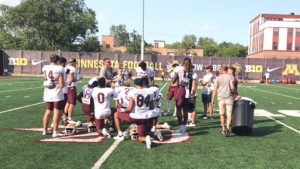
U football practice in 2021.

In a short time a lot will be decided about the college football model. There will be protests from other college sports if football players are receiving salaries and other athletes aren’t. Those differences, Hsu suggests, could even lead to schools like Minnesota selling off the football program to an outside entity that runs Golden Gophers football. Other sports could remain under University control and benefit as they do now from football profits.

There is speculation the Big Ten may further expand its membership. While schools are lined up at the door to join the conference, new members could reduce the slice of revenue pie for existing members. Applicants will have to bring considerable value monetarily and fit the academic pedigree of Big Ten institutions.

“Let’s face it, everybody wants to join the Big Ten now with the mega TV contract that’s coming up,” Maturi said. “And that’s gotta be decided by the commissioner (Kevin Warren) and the presidents and chancellors of the Big Ten.”

Looming as a big prize is Notre Dame, the juggernaut football independent that could make more TV money joining the Big Ten but would have to sacrifice controlling its schedule of opponents and perhaps lessen its chances of qualifying for the college football playoff.

“Right now Notre Dame is leaving money on the table,” Maturi said. “It already has. They don’t get the money from NBC that they would have gotten by joining a (major) conference, but they’ve kept what they believe is their mission, their values, their principles—and how long they’ll be able to continue to do that remains to be seen.”

Former Gophers football coach Glen Mason can see a Big Ten with 20 teams. “I don’t think we’re done yet (with expansion). I think there’s going to be two premier conferences. The way I see it as a fan, it will be the Big Ten and SEC. Probably both eyeing…to get 20-team leagues.”

Mason isn’t sure if he approves of pay-for-play but he recognizes players are in a far different world than when he competed for Ohio State in the early 1970s. “It was not a year round job,” Mason said.

In Mason’s day winter conditioning was minimal and after spring football practices ended players went home. Big Ten teams played 10 game schedules and only one team could participate in a bowl game. Ticket prices to watch conference teams was minimal and coach’s salaries were modest. Now college football players see coaches making $4 million to $10 million per year while athletic departments generate mega revenues via TV and other sources. “I think players said all of a sudden, hey, wait a minute,” Mason told Sports Headliners.

Mason looks at schools like USC, UCLA, Oklahoma and Texas jumping leagues and asks where is the loyalty to their conferences? The Sooners and Longhorns are leaving the Big 12 and bolting for the SEC, just like USC and UCLA are on their way out of the Pac-12. Those moves create a lot of problems and stress for the remaining members of their conferences.

When Mason coached at Kansas in the Big Eight the power players were Oklahoma and Nebraska. Those schools questioned whether they should share revenues in the same amounts as their Big Eight peers, or keep more for themselves.

“You can see the disparity in that,” Mason said. “Those discussions when I came back to the Big Ten, those never came up. You never had the big dogs on the block, Ohio State and Michigan, talking about that. They realized they were partners in the Big Ten and even though they might be the guys driving the train, that’s just the way it was.”

In the new world of college football it’s more business focused than ever. “We’re lucky we have the membership in the Big Ten,” Hsu said about Minnesota.

Comments Welcome
Gophers Earn Preseason Recognition

Posted on June 19, 2022June 19, 2022 by David Shama


With the Gophers’ opening game against New Mexico State approaching two months out, preseason publicity for Minnesota football is coming from national sources. The trend is to laud center John Michael Schmitz and label the team a dark horse to win the Big Ten West Division.

Athlon Sports has Schmitz as its first team preseason All-American center. Lindy’s Sports lists the Gopher senior as the second best center in the nation behind Notre Dame’s Jarrett Patterson. Perhaps no source commands more respect annually than Phil Steele Publications. That outlet also named Schmitz a second team preseason All-American.

Schmitz and eight other Gophers have earned recognition from Phil Steele. Schmitz was named first team All-Big Ten, while defensive tackle Trill Carter and running back Mo Ibrahim are second teamers. Offensive lineman Chuck Filiaga, rush end Thomas Rush, linebacker Mariano Sori-Marin, long snapper Brady Weeks and wide receiver Dylan Wright are third team All-Big Ten. Running back Trey Potts was named to the fourth team offense.

Gophers drawing recognition from Lindy’s include wide receiver Chris Autman-Bell and tight end Brevyn-Spann Ford, both named third team All-Big Ten. Safety Tyler Nubin and punter Mark Crawford earned third team defense recognition along with Sori-Marin. Ibrahim is included on the second team offense.

Lindy’s predicts the Gophers will finish fifth in the West Division behind Wisconsin, Iowa, Purdue and Nebraska. The magazine frets about the quality of the offensive and defensive lines, and points out quarterback performance must improve.

Mo Ibrahim

Athlon forecasts Minnesota placing fourth behind Wisconsin, Purdue and Iowa. Minnesota’s record will be 7-5 overall, 4-5 in the Big Ten, per Athlon. Ibrahim is a member of the magazine’s All-Big Ten second team while Sori-Marin and Nubin are third teamers on defense.

Ouch. If there’s one place Gophers fans don’t want to return for a bowl game, it’s Detroit. But that’s where Athlon says Minnesota will have a date in the Quick Lane Bowl against Central Michigan. If that rendezvous works out, there could be Christmas parties that attract larger crowds.

Minnesota coach P.J. Fleck’s teams have been known to exceed expectations. His 2019 and 2021 teams both surprised prognosticators with respective records of 11-2 and 9-4. The 2019 team finished a stunning No. 10 in the country in two polls and last year’s Gophers won a third consecutive bowl game under Fleck. In his last 39 games he has a 27-12 record with the Gophers.

A prickly subject is Minnesota’s streak of seven consecutive losses to Iowa dating back to 2014 (Fleck’s first Gopher team was 2017). You can bet defeating Iowa November 19 in Minneapolis is a Row the Boat obsession.

Minnesota has won two of its last four games in its other border rivalry. Wisconsin could be the school to beat in a West Division that in preseason national rankings will be without a top 10 team. The division isn’t daunting and the Gophers, despite having to play five conference road games versus four at home, will be thinking “why not us?”

The first four games of the 12-game schedule should tell a lot about the season. The Gophers need to start 3-0 against nonconference opponents New Mexico State, Western Michigan and Colorado (all at home). They need to play at a high level, win or lose, in their Big Ten opener September 24 at Michigan State. The Spartans are one of the better teams in the East Division and possible top 20 program in 2022.

Cornerback Justin Walley, named to the 247Sports True Freshman All-American team last year, is being slighted in early recognition of Big Ten players. But his team is, too, and you can be sure Walley and the Gophers will value accolades at season’s end a lot more than in June.

Gophers Football Notes

If the Gophers win the West Division they will face an intimidating history in the Big Ten championship game against the East Division representative. The West champion is 0-8 in Big Ten title games.

Fleck makes his annual appearance before the Twin Cities Dunkers Thursday at Interlachen Country Club.

Grumbling Penn State fans don’t think the Gophers are worthy of being designated their annual White Out game opponent. Minnesota plays in Happy Valley October 22.

Former Gophers two-time All-American tackle and Outland Trophy winner Bobby Bell turned 82 Friday.

Ex-Minnesota head coach Glen Mason took a bad fall earlier this year, fracturing seven ribs. However, he told Sports Headliners he is “going strong now.”

The Goal Line Club will again raise money for the football program by staging its annual golf tournament. The Gopher Football Golf Classic at StoneRidge Golf Club in Stillwater is open to Goal Line Club members and their guests. More at the Goal Line Club website.

1 comment

Glen Mason: Marion Barber a ‘Delight’

Posted on June 5, 2022June 5, 2022 by David Shama


Glen Mason remembers the last time he saw Marion Barber III. It was not long after Barber retired following the 2012 NFL season and he was back in town.

Over the years Barber called his former Gopher coach and this time he wanted to have dinner. Barber was thinking of moving back to Minnesota where his parents and siblings lived.

Mason said to come over to his house for dinner. Barber, who didn’t drink alcohol, arrived with an expensive bottle of champagne. He insisted Mason drink the whole bottle, while it was at its bubbly-best that evening.

“I am not a big drinker,” Mason told Sports Headliners Friday. “I got half shit-faced. I mean he was laughing at me. He said, ‘Coach, you’re slurring your words.’ I said, Marion, it’s your fault.”

Police from Frisco, Texas found Barber, age 38, dead in his apartment several days ago. Media reports are police were at the apartment as part of a wellness check but the cause of death hasn’t been publicized.

Barber had been detained by police in Texas in 2014 and given a mental health evaluation. The online Fort Worth Star-Telegram reported recently that a year ago former Dallas Cowboys teammate Dez Bryant tweeted that “he’s down and out bad.”

After leaving the Gophers and Mason following the 2004 season, Barber became a key contributor as a running back for the Cowboys. He played six seasons with Dallas, then finished up his pro career playing for the Chicago Bears.

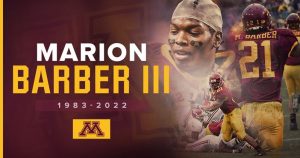
Image courtesy of Gopher sports.

Mason, who was Minnesota’s head coach from 1997-2006, believes the last time he talked by phone with Barber was about 18 months ago. He wanted to fly down to Texas, show up at Barber’s door and the two could spend time together. Mason didn’t know specifically what Barber’s issues were, but he was aware there were problems.

The coach was aggressive about arranging a visit but Barber pushed back and said he was busy. “Well, after I did that, any time I called him, he didn’t take my call and he didn’t return my call,” Mason remembered.

Most of the world, including in Minnesota, knows Barber’s name as a football player. Mason, who saw Barber almost every day from 2001-2004, will tell you that as good as the former All-Big Ten running back was on the field, he was a better person.

“The kid was a delight. When I thought of Marion Barber I did not think of him as the football player. I thought of him as the kid walking down the hall.

“He was kind of shy. …I wouldn’t say he was a class clown but he was kind of a practical joker. He’d give you a laugh all the time.

“Everybody liked Marion. Over a four-year period, he didn’t give me one minute (of a) problem. He never did anything wrong. I don’t know of a player I liked more than Marion Barber.”

About a month ago Mason was down in Florida and encountered Bill Parcells, Barber’s first head coach with the Cowboys. The Pro Football Hall of Fame coach told Mason that Barber was one of his favorite players. “That guy knew how to play football,” Parcells said.

Barber played high school football at Wayzata before attending Minnesota. Younger brothers Dom and Thomas followed Marion to the Gophers. Their father, Marion Barber Junior, was a great running back for Minnesota in the late 1970s.

It was suggested to Mason the family’s legacy at the University of Minnesota is unique—that the Barbers are the first family of Golden Gophers football. “All contributors, all-stars in their own right. I can’t think of a (comparable college football) program,” Mason said.

Mason revels in telling the story of how Barber came to his program. Although a successful running back and defensive back at Wayzata, there was minimal interest from college coaches. “Really no one was recruiting him, no big schools including us,” Mason recalled.

Mason lived within a short drive of Wayzata High School so he was aware of Marion. Another connection to the Barber family was that in the 1970s Mason was an assistant coach at Illinois when the Illini were recruiting Marion Jr.

As the recruiting period in 2001 was drawing to a close Mason questioned his staff about whether a scholarship should be offered to young Marion as a defensive back. Mason received push back from the staff and one assistant asked what made the boss believe Barber could play defensive back in the Big Ten. Mason answered because Barber was the one defender who intercepted Cretin-Derham Hall quarterback Joe Mauer.

Mason brought Barber to campus and offered him a scholarship—as a defensive back. No, thanks.

Barber insisted he was a runner and declined the offer.

A few weeks later Mason encountered Marion Jr. and inquired if his son had college offers cooking. The answer was no, so the persistent Gopher coach called Marion III and again offered a scholarship as a defensive back. “If you’ve got any sense you’ll take it,” he told Barber.

This time Barber accepted but the teenager soon showed his own persistence to Mason. While still in high school, Barber called and asked for a meeting.

He had a proposal. Let him play running back for his first season at Minnesota and if it didn’t work out he would be willing to play any position for the Gophers. Mason figured why not accept the deal because Barber wasn’t going to see the field anyway in his first year with the program.

But months later, at the first day of practice, the freshman running back was making an impression. After about 30 minutes running backs coach Vic Adamle told Mason the coaches had misjudged Barber and “this kid is good.”

Mason won’t take credit for how Barber surprised everyone from the start of his college career. “We gave a kid a chance mainly because his dad was a player here. If you can’t take care of your own, then shame on you. He did it all on his own and proved everybody wrong.”

Mason, whose previous head coaching stops also included Kent State and Kansas, can’t say exactly why Barber was misjudged out of high school and was so special immediately in college. He has a theory, though, that for whatever reason many Minnesota prep football players are late developers. He saw this prove out over and over again at the U, including with offensive linemen.

Barber ranks fifth all-time in rushing yards at Minnesota with 3,276. His 35 rushing touchdowns rank second and his 575 career carries are seventh. He made first-team All-Big Ten in 2003.

He and Laurence Maroney were the first pair of NCAA running backs to each produce 1,000 yard seasons in consecutive years on the same team. After Barber ran for 975 yards and 10 touchdowns for the Cowboys in 2007 he was selected for the Pro Bowl.

Barber deserves a place among the best U running backs ever. No one might have run harder, had more determination. Yet he could be shifty with a burst of speed, too. He also excelled as a pass receiver and the Gophers sometimes used him as a slot receiver to put both he and Maroney on the field at the same time. “He was just a tremendous running back,” Mason said.

With a love of contact, ferocious might be the word best describing Barber’s running style. “Strong, bruising runner,” Mason said. “I think it got to the point where people knew if you’re going to play Minnesota you better buckle it on. …”

1 comment

Posts pagination

  • Previous
  • 1
  • …
  • 70
  • 71
  • 72
  • 73
  • 74
  • 75
  • 76
  • …
  • 317
  • Next
  • Home
  • Biography
  • Contact
  • Privacy Policy
  • Terms of Use

Search Shama

Archives

  KLN Family Brands   Meyer Law   Iron Horse  

Recent Posts

  • Indiana Football Success Hangs Over Gopher Program
  • Vikes Revel in State Hosting ’28 NFL Draft, Consider Combine
  • U AD: Golden Gophers in Good Spot in Rev Share, NIL
  • Gopher Men’s Hoops Not Starting Series with Tommies
  • U AD Talking Niko Medved & Dawn Plitzuweit Contracts
  • Don’t Expect Solo Act from New Vikings General Manager
  • Poor Arizona Defenses Did QB Kyler Murray No Favors
  • Twins Nix Royce Lewis June 6 Jersey Giveaway
  • Can Baseball Save Memorial Day?
  • U 2027 Recruiting Class Ranks High But Linemen Hold Key

Newsmakers

  • KEVIN O’CONNELL
  • BYRON BUXTON
  • P.J. FLECK
  • KIRILL KAPRIZOV
  • ANTHONY EDWARDS
  • CHERYL REEVE
  • NIKO MEDVED

Archives

Read More…

  • STADIUMS
  • MEDIA
  • NCAA
  • RECRUITING
  • SPORTS DRAFTS

Get in Touch

  • Home
  • Biography
  • Contact
  • Privacy Policy
  • Terms of Use
Dinkytown Athletes

Murray's Restaurant

Meadows at Mystic Lake

Blaze Credit Union

Iron Horse | KLN Family Brands | Meyer Njus Tanick
© 2026 David Shama's Minnesota Sports Headliners | Powered by Superbs Personal Blog theme
We use cookies to ensure that we give you the best experience on our website. If you continue to use this site we will assume that you are happy with it.